No products in the cart.
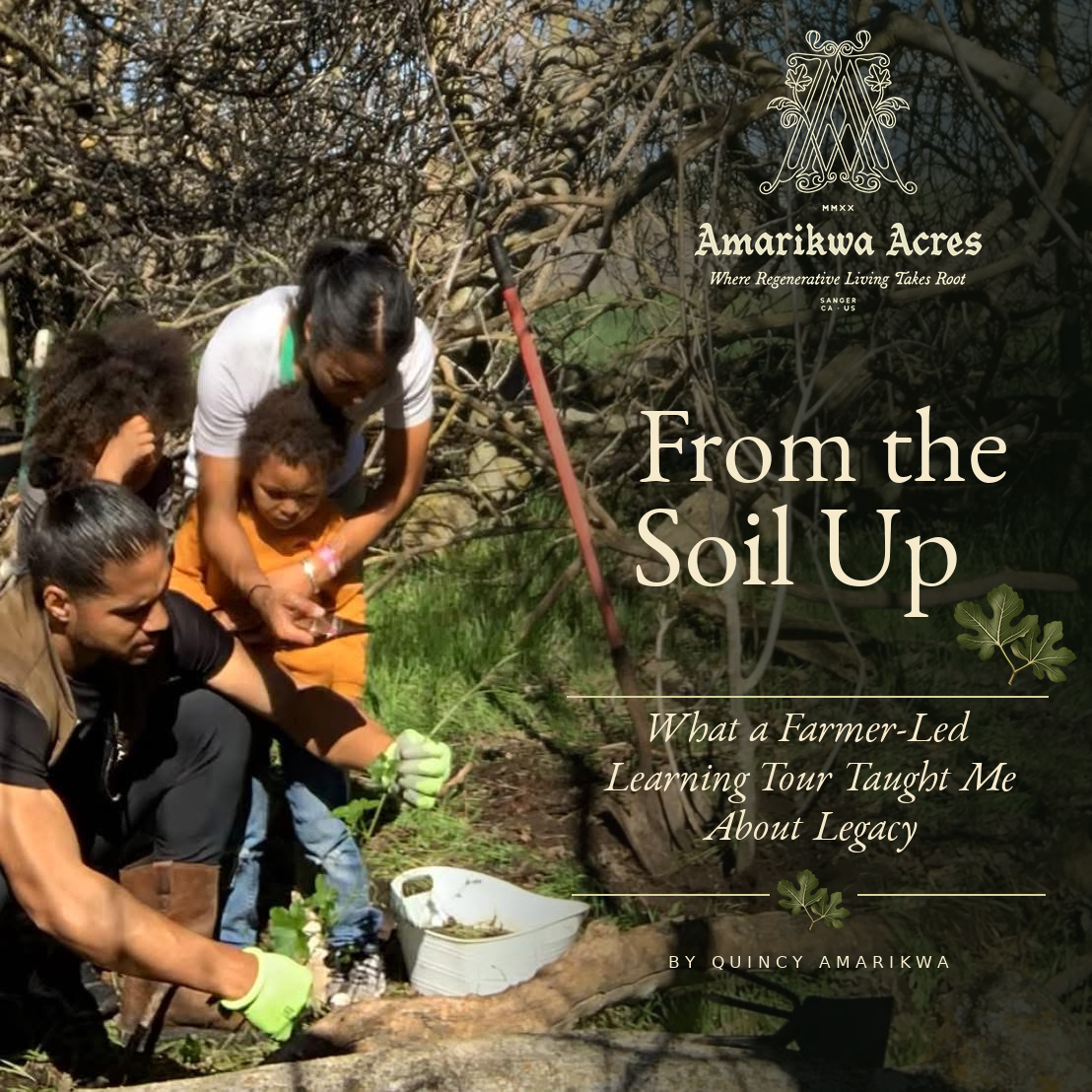
From the Soil Up: What a Farmer-Led Learning Tour Taught Me About Legacy
-
by
Quincy Amarikwa
- No Comments on From the Soil Up: What a Farmer-Led Learning Tour Taught Me About Legacy
By Quincy Amarikwa | Amarikwa Acres
It started with a question about soil.
We were standing near the base of a tree at Fukagawa Farms during the October 20, 2026, Farmer-Led Learning Tour, organized through the Farmer Ag Network (FAN) in collaboration with CalCAN and partners including the Mighty Arrow Foundation and Sierra Resource Conservation District.
The first question I was asked that day came while we were examining the soil beneath that tree.
At the time, I was there to do what I’d come to do: listen, learn, support the Network, and connect with others working to advance regenerative agriculture throughout California’s San Joaquin Valley.
I wasn’t expecting to speak to the group that day, and I certainly wasn’t anticipating how much the experience would influence my thinking about something much larger than agriculture.
But that’s often how these things go.
One question leads to another. One conversation creates a connection. And before you know it, you find yourself thinking about something entirely different from where you started.
Or at least that’s how my mind tends to work.
Looking back, there’s something fitting about the entire experience beginning with the soil.
Because what I ultimately left thinking about was the importance of everything we build beneath the surface.
An Entrepreneur Who Happens to Farm
For those unfamiliar with my background, I’m an entrepreneur who happened to play professional soccer for 13 years.
My wife, Sirena, and I have spent years building businesses and purpose-driven organizations across sports, education, entrepreneurship, and community development.
During the pandemic, our family purchased 43 acres just outside Fresno, in Sanger, California, where we’ve been developing Amarikwa Acres, focusing primarily on figs, regenerative agriculture, soil health, and responsible land stewardship.
Alongside our agricultural work, we have the Amarikwa Family Foundation, our nonprofit organization focused on education, community development, and creating meaningful opportunities for others.
Like many farmers, we’re learning through experience, navigating challenges, and making plenty of mistakes along the way.
And if there’s one thing I’ve learned about myself throughout my entrepreneurial journey, it’s that I have a tendency to make the same mistake regardless of the industry I’m working in.
I turn almost everything I do into a purpose-driven endeavor.
I’ve done it in sports, education, entrepreneurship, and now agriculture.
I’ll identify an opportunity, begin developing a solution, and work toward establishing an economic model capable of sustaining it.
But somewhere along the way, I often find myself becoming more interested in the potential impact than the financial return.
For a long time, I’ve viewed that tendency as a mistake.
But I’m beginning to understand that the mistake isn’t necessarily pursuing purpose.
It’s failing to establish the economic infrastructure necessary to sustain it.
Profitability isn’t the opposite of purpose. It’s one of the mechanisms that allows purpose to endure.
And while I understand the importance of generating profit, I’ve also recognized that profitability alone has never been enough to sustain my interest.
Profit is a mechanism.
Legacy is the objective.
What Happens Beneath the Surface
Throughout the day, we had an opportunity to visit Fukagawa Farms and Cardoza and Cardoza Farms.
We heard directly from farmers about their experiences, challenges, successes, and approaches to regenerative agriculture.
We discussed soil health, water conservation, farm viability, land stewardship, and the importance of practical knowledge developed through years of working the land.
We also had an opportunity to see Don Thomas demonstrate how different soil conditions and management practices affect water infiltration and runoff through his Rain Simulator.
What stood out to me was the value of bringing people together to see these practices firsthand.
There’s something different about standing on a farm, listening to the people responsible for managing it, and understanding the decisions they’re making in real time.
The knowledge isn’t simply theoretical.
It’s earned through experience.
And as the conversations continued, I found myself making connections between what we were discussing in the fields and what I’ve been thinking about in my own businesses.
Healthy soil doesn’t happen simply because we want it to.
It requires understanding the conditions, inputs, relationships, and processes that allow a productive ecosystem to develop.
And even when those conditions are established, they require continued observation, management, and adaptation.
Circumstances change.
New challenges emerge.
What worked before may require adjustment.
I began thinking about families, businesses, and institutions in much the same way.
We often focus on what we can see.
The successful business.
The profitable farm.
The charitable contribution.
The wealth accumulated.
But what about the systems beneath those outcomes?
Who makes the decisions?
How are resources managed?
How is knowledge transferred?
What happens when leadership changes?
And what prevents an institution from eventually consuming the very resources that made its existence possible?
These are the questions I’ve increasingly been exploring.
A Different Perspective on Family and Legacy
Another aspect of the tour that left an impression on me was the participation of representatives from the Mighty Arrow Foundation.
Beyond their interest in regenerative agriculture, I was particularly intrigued by what appeared to be multiple generations of a family participating in the experience together.
I don’t know the details of how their organization or family operates, but observing that participation prompted me to reflect more deeply on what I’m trying to establish for my own family.
I saw what appeared to be a shared interest in learning, supporting meaningful work, and contributing to something larger than any individual.
It made me think about the relationships, resources, systems, and governance required to sustain that kind of collective effort across generations.
And it brought me back to a question I’ve been thinking about for some time.
What would it take to build something that continues creating value thousands of years into the future?
I understand that no individual can guarantee that kind of longevity.
That’s precisely why the question interests me.
It forces me to think beyond individual businesses, personal accomplishments, or even the lifetimes of my children.
I’m beginning to envision the organizations and ventures we’ve established as interconnected components of a much larger family institution.
An institution designed to create, preserve, and expand economic, intellectual, social, and environmental value across generations.
Not simply a successful business.
Not just a collection of assets.
And certainly not a system that allows future generations to survive indefinitely on what previous generations created.
I’m interested in building something that continuously creates opportunities for meaningful contribution.
Something that doesn’t depend on me, or any one individual, to survive.
Opportunity Should Be Inherited. Compensation Should Be Earned.
One of the foundational principles I’m exploring is the distinction between opportunity and entitlement.
I want future generations of the Amarikwa family to have access to meaningful opportunities.
But I don’t believe being born into the family should automatically entitle someone to a salary, leadership position, or control over institutional resources.
Those responsibilities and rewards should be earned through demonstrated contribution, competence, accountability, and performance.
My vision is for the institution to retain and protect its core assets while creating pathways for family members and others to contribute according to their interests and capabilities.
That might mean working in agriculture, technology, education, finance, operations, research, or industries that don’t even exist today.
Some individuals may build businesses.
Others may maintain infrastructure, develop educational programs, manage investments, or create opportunities for the next generation.
The objective isn’t to guarantee everyone a position.
It’s to establish an equitable system in which individuals have the opportunity to develop the skills necessary to contribute, earn appropriate compensation, and advance according to their capacity to meet clearly defined responsibilities and expectations.
In other words, the institution should continuously create opportunities without becoming dependent on entitlement.
And those principles should apply to everyone.
Including me.
Critical Thinking: The Engine of Perpetual Evolution
There’s another component of this vision that I believe may be even more important than the businesses themselves.
The ability to think critically.
If my experiences in professional sports and entrepreneurship have taught me anything, it’s that circumstances rarely remain the same for long.
The strategies that helped me succeed as a professional soccer player weren’t always the strategies I needed as an entrepreneur.
And the knowledge I’ve gained building businesses doesn’t automatically make me a successful farmer.
Each environment requires new understanding.
New approaches.
And often, the willingness to recognize that what you thought you knew may no longer apply.
Through the Mental Strength League (MSL), I’ve been exploring how we can develop individuals capable of questioning assumptions, evaluating information, making informed decisions, and adapting to changing circumstances.
I envision MSL becoming the developmental engine of the larger institution.
Because the systems that work today may not be appropriate 50, 100, or 1,000 years from now.
And if future generations are simply instructed to preserve everything we’ve established without questioning it, the institution will eventually become limited by our current understanding.
Instead, I want to help develop people capable of understanding why systems exist, evaluating whether they’re still effective, and improving them when necessary.
Including the systems I establish.
The mission should endure. The methods must be allowed to evolve.
To me, that’s what makes critical thinking so important.
The ultimate objective isn’t to establish a perfect system that future generations are responsible for preserving.
It’s to establish the principles, incentives, and capabilities that allow future generations to continually build better systems.
Why Farmer-Led Networks Matter
This brings me back to the Farmer Ag Network.
What I appreciate about FAN is the opportunity to connect people who possess different experiences, resources, and perspectives around a shared interest in improving agriculture.
Farmers have practical knowledge.
Researchers bring technical expertise.
Educators help develop future generations.
Entrepreneurs identify opportunities and build systems.
Philanthropic organizations can provide resources that help promising ideas move forward.
But the real opportunity exists in how effectively these groups learn from and support one another.
Regenerative agriculture is often discussed in terms of improving soil health, managing water, and restoring ecosystems.
Those outcomes matter.
But I also believe we should be thinking about regenerating the economic, educational, and institutional systems surrounding agriculture.
How do we make farming financially sustainable?
How do we create meaningful opportunities for young people?
How do we preserve knowledge while remaining open to new approaches?
How do we create systems that reward contribution without encouraging entitlement?
And how do we establish organizations that continue creating value long after their founders are gone?
These aren’t exclusively agricultural questions.
They’re institutional questions.
But perhaps agriculture provides an especially useful environment for exploring them.
After all, when we work with the land, we’re constantly reminded that our actions today influence the conditions future generations will inherit.
From the Soil Up
Toward the end of the tour, I was unexpectedly asked to share a few words with the group.
I spoke about my background, our farm, the organizations we’ve established, and some of the connections I’d made throughout the day.
Afterward, I found myself reflecting on what I had shared and, more importantly, what I wished I had communicated.
I felt I could have done a better job organizing my thoughts.
I had spent much of my time describing how we’d arrived where we are rather than articulating where I believe we’re going.
And that realization stayed with me.
Because the more I think about our work at Amarikwa Acres, the more I recognize that agriculture is becoming a practical environment for testing principles that extend far beyond farming.
How do we build something economically viable?
How do we develop people capable of sustaining it?
How do we protect what matters while remaining open to change?
And how do we establish systems that continue creating value long after we’re gone?
I’m grateful to Debbie Thomas, the Farmer Ag Network, CalCAN, Sierra Resource Conservation District, the Mighty Arrow Foundation, and the participating farmers – Steve Fukagawa, Steven Cardoza and Andrew Carroll for sharing their knowledge, experiences and perspectives throughout the day.
I came intending to listen, learn, and support.
I left thinking more deeply about the institution I hope to build for my family and the communities we’re connected to.
About how we develop people, preserve knowledge, create opportunities, manage resources, and establish systems capable of continuously improving themselves.
We’re still early in the process, and I certainly don’t have all the answers.
But I’m becoming increasingly convinced that if we want something to last, we have to pay attention to the conditions we’re creating beneath the surface.
Whether we’re talking about a tree, a farm, a business, a family, or an institution.
What we’re able to grow tomorrow depends, in large part, on what we’re willing to cultivate today.
And for me, that’s where the conversation about legacy begins.
From the soil up.
Quincy Amarikwa is an entrepreneur, former professional soccer player, regenerative farmer, and Farmer Ag Network Steering Committee member. Alongside his wife and family, he is developing Amarikwa Acres, a 43-acre regenerative farm in Fresno/Sanger, California, while continuing his work across entrepreneurship, education, coaching and community development.
Learn more at QuincyAmarikwa.com.